|
 Summer is here!! Here we are at the start of another camping season promising to be another
hot one again. June weather was sort of lukewarm pretty much everywhere but warmed up quickly just before Canada Day! Like everyone, we were hoping for a "forest fire free" summer but according to Feredal officials it's unlikely to
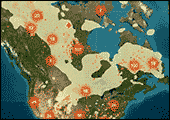
happen as on June 28th, we already had 134 active fires burning across the country which had already consumed more than 113,30 hectares! To keep an eye on forest fire issues, you can monitor nationwide conditions and evolving fire
dangers using the
Natural Resources Canada Forecast tool
Also note that Environment and Climate Change Canada (ECCC) projected 2026 to be among the four hottest years on record globally!! You can also see a map of fire weather forecasts as well as smoke forecasts
on the FireSmoke website. Summer is here!! Here we are at the start of another camping season promising to be another
hot one again. June weather was sort of lukewarm pretty much everywhere but warmed up quickly just before Canada Day! Like everyone, we were hoping for a "forest fire free" summer but according to Feredal officials it's unlikely to
happen as on June 28th, we already had 134 active fires burning across the country which had already consumed more than 113,30 hectares! To keep an eye on forest fire issues, you can monitor nationwide conditions and evolving fire
dangers using the
Natural Resources Canada Forecast tool
Also note that Environment and Climate Change Canada (ECCC) projected 2026 to be among the four hottest years on record globally!! You can also see a map of fire weather forecasts as well as smoke forecasts
on the FireSmoke website.
If and when you decide to go camping, please ensure that your destination is safe before heading out... and once you're over there verify for local fire bans and if allowed, keep campfires small and attended. We also recommend to bring supplies to deal with "smoky" conditions and if air quality hits hazardous levels, consider packing up and heading home.
Whether you're a seasoned camper of a new camper, we have put information together that should prove to be useful. As a starter, check our
"" if you haven't yet "de-winterized" your RV. Before you head out, take some time to check our
Camping tips and our
Camping trip checklist
to make sure you don't forget anything for your trip. We have even put together a Trip planing tips to help you get started. And if you're towing an RV, check out our Towing tips Towing tips and our RV tips pages. Note that our tips sections also include tips on how to start a campfire, tie knots and more.
If or when you're in the market for an RV, click here to read about the various types (classes) of RVs available on the market. You can buy a "towable" RV or you can buy a "motorized" RV. You can have slideouts, AC, bunk beds.... or hundreds of other options. You can buy a 12 footer or you can buy a 45 footer. It all depends on your needs and to help you with your buying process, we have put together an "RV selection guide" as well as two checklists; our "RV shopping checklist" and our "Buying a used RV checklist". Print these and bring them with you on your next shopping trip!
Before the new season starts, why not help out fellow campers and rate/review the campgrounds that you have visited in the past. Everybody loves to readcampground reviews especially reviews made by real campers.  We use a "5-point rating system" allowing you to rate a campground based on its location, services, campsites, recreation facilities and washrooms. Please note that we recently added two new features. One allows you to add photos to your campground reviews and the other one allows you to create your own camping journal by adding personal notes to your reviews. Those notes can only be viewed by you and can be used to store information such as the date of visit,campsite number or any other information that you wish to keep about your visit. "Click here" to read existing reviews and/or review a campground. We use a "5-point rating system" allowing you to rate a campground based on its location, services, campsites, recreation facilities and washrooms. Please note that we recently added two new features. One allows you to add photos to your campground reviews and the other one allows you to create your own camping journal by adding personal notes to your reviews. Those notes can only be viewed by you and can be used to store information such as the date of visit,campsite number or any other information that you wish to keep about your visit. "Click here" to read existing reviews and/or review a campground.
|
 |
|
|
| |
|
|
| |
| Upcoming Canadian RV shows |
|
|
Information above provided by organizers / third parties. Camping Canada does not warrant or guarantee the accuracy.
|
|
|
| |
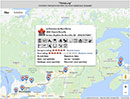
"KampMap"!
We recently added a "KampMap" which is a tool that allows you to visually keep track of all the campgrounds that you have visited and reviewed to date using our campground review tool. It basically works like this.......every time you review one of our campgrounds, we create a new marker on your own KampMap (a Google map) which includes information for this campground as well as a link to it's listing, a link to your own review and a link to all the reviews done to date for this campground. The map is fully interactive with zoom-in, zoom-out features.
|
| |
| How would you like to see your camping photos featured on our pages? Send us your very best photos as full resolution files at photos@camping-canada.com! With any photo submitted, please include your full name and a caption stating when and where the photo was taken as well as a title for the photo. |
| |
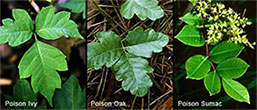 Poison ivy typically grows as a vine or shrub, and it can be found throughout much of North America. Poison ivy plants typically have leaf arrangements that are clustered in groups of three leaflets. The plant may have yellow or green flowers, and white to green-yellow berries, depending on the season. Poison oak also grows as a vine or shrub and is found in the western United States and British Columbia. It has a leaf arrangement similar to poison ivy. Poison sumac on the other hand, grows as a shrub or small tree and is only found in eastern/southeastern United States. When infected by one of these, you get a rash within 12-72 hours. Skin may become red, swollen and/or itchy. Rash usually appears bumpy, streaky and linear. Fluid may discharge from blisters but isn't contagious. Within 20-30 minutes of exposure, rinse the affected area with lots of warm water to remove the oily plant resin. You can also use soap or rubbing alcohol to help with the resin removal. The rash slowly improves and disappears after one to three weeks in most individuals. For more information about poison ivy, click here.
If you're looking for homemade remedies for poison ivy, click here to read an interesting article from TipsBulletin!
Poison ivy typically grows as a vine or shrub, and it can be found throughout much of North America. Poison ivy plants typically have leaf arrangements that are clustered in groups of three leaflets. The plant may have yellow or green flowers, and white to green-yellow berries, depending on the season. Poison oak also grows as a vine or shrub and is found in the western United States and British Columbia. It has a leaf arrangement similar to poison ivy. Poison sumac on the other hand, grows as a shrub or small tree and is only found in eastern/southeastern United States. When infected by one of these, you get a rash within 12-72 hours. Skin may become red, swollen and/or itchy. Rash usually appears bumpy, streaky and linear. Fluid may discharge from blisters but isn't contagious. Within 20-30 minutes of exposure, rinse the affected area with lots of warm water to remove the oily plant resin. You can also use soap or rubbing alcohol to help with the resin removal. The rash slowly improves and disappears after one to three weeks in most individuals. For more information about poison ivy, click here.
If you're looking for homemade remedies for poison ivy, click here to read an interesting article from TipsBulletin! |
| |
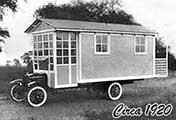 The RV industry has evolved tremendously over the last 100 years! This industry directly and indirectly supported an estimated 67,200 jobs and delivered $4.8 billion in added economic value to the
 Canadian economy in 2019. It is estimated that approximately 2.1 million Canadian households currently own an RV and this number has been increasing exponentially since Covid-19 began!With more than 4,300 campgrounds across Canada, additional investments in ourcamping and RV infrastructures is likely to improve the Canadian tourism industry.
If you want to view pictures of RV's over the last 100 years, click here. Canadian economy in 2019. It is estimated that approximately 2.1 million Canadian households currently own an RV and this number has been increasing exponentially since Covid-19 began!With more than 4,300 campgrounds across Canada, additional investments in ourcamping and RV infrastructures is likely to improve the Canadian tourism industry.
If you want to view pictures of RV's over the last 100 years, click here.
|
| |
Parks Canada recently announced that they will double the number of its new 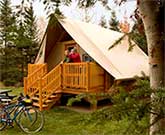 "oTENTik" camping structures in national parks and other locations across the country this year! An "oTENTik" structure is basically a crossbetween a tent and a cabin and is intended to add a degree of comfort to camping (see "Glamping" below). After rolling out a few dozen of the units in 2013, initially at La Mauricie National Park in Quebec, Parks Canada made 124 available across the country last year, mostly in national parks but also at a couple of national historic sites in B.C. This year the number of units will hit 238, said Francois Duclos, Parks Canada manager of visitor experience infrastructures and the rental cost ranges from $90-$120 a night for a unit that can accommodate six people. Click here for more information! "oTENTik" camping structures in national parks and other locations across the country this year! An "oTENTik" structure is basically a crossbetween a tent and a cabin and is intended to add a degree of comfort to camping (see "Glamping" below). After rolling out a few dozen of the units in 2013, initially at La Mauricie National Park in Quebec, Parks Canada made 124 available across the country last year, mostly in national parks but also at a couple of national historic sites in B.C. This year the number of units will hit 238, said Francois Duclos, Parks Canada manager of visitor experience infrastructures and the rental cost ranges from $90-$120 a night for a unit that can accommodate six people. Click here for more information!
|
| |
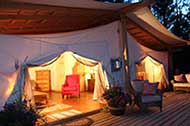 Camping in style!! Camping in style!!
Have you ever heard of "Glamping"? No.... well, you're not alone! "Glamping", which stands for "glamorous camping",started in Europe a decade ago. No more kerosenelamp, no more heating a can of beans on a campfire! Hello solar lamps, bed, kitchen-range, comfy chairs.... all under a tent! Europeans refer to these places as "open air hotels". Now, it's starting to catch on in Canada! Some setup are simply large canvas tents with some furniture such as a chair and a bed while others offer more luxury. Prices range from under $100 for a single night with a cot, to around $1000 for four nights with a queen bed!
At the moment, glamping is more popular in BC but it's slowly catching on in the rest of canada. Click here to view a map of Glamping spots in Canada. |
| |
|
|
| |
If you are a campground owner and you would like to get your campground listed in "Camping-Canada.Com"....
"Click here"
to get more information.
|
|
| |
|
|